
数书九章
Shu Jiuzhang
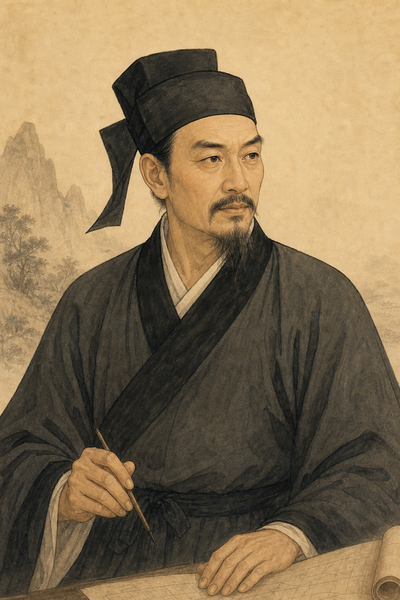
Mathematical Treatise in Nine Sections, completed by Qin Jiushao in 1247 CE, is a summit of Song dynasty mathematics. It presents the Chinese Remainder Theorem in full generality, solves simultaneous …
About This Work
Mathematical Treatise in Nine Sections, completed by Qin Jiushao in 1247 CE, is a summit of Song dynasty mathematics. It presents the Chinese Remainder Theorem in full generality, solves simultaneous linear equations via matrix-like methods, and provides a numerical algorithm for polynomial equations of arbitrary degree—essentially Horner's method, discovered 570 years earlier.
Contents · 内容
Why This Matters
This text is part of the living archive of Chinese intellectual achievement — a tradition that produced systematic astronomical observation, mathematical innovation, medical frameworks still in clinical use, and engineering at continental scale, centuries before comparable developments in Europe.
The question "did ancient China have science?" misunderstands what science is. Science is not a single cultural tradition — it is the systematic observation of nature, the rigorous documentation of phenomena, the testing of ideas against evidence, and the building of knowledge across generations. By every one of these measures, the works in this catalogue are scientific. They used different conceptual frameworks — correlative rather than mechanistic, systemic rather than reductionist — but these frameworks produced real knowledge: accurate star catalogues, effective medical treatments, precise calendar computations, and technologies that transformed civilization.