
道德经
Tao Te Ching
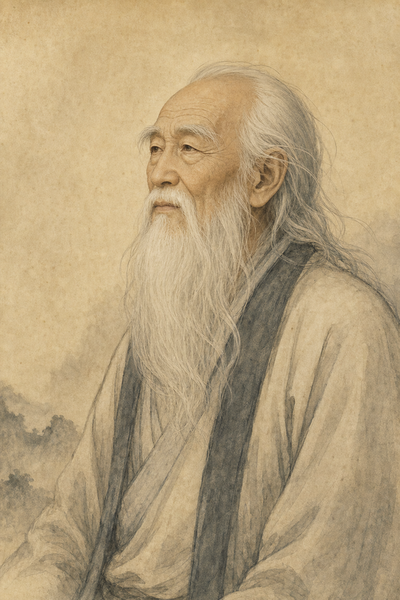
The Dao De Jing is not mysticism — it is a rigorous philosophical system that established the foundational framework for Chinese scientific observation. Attributed to Laozi during the late Spring and …
About This Work
The Dao De Jing is not mysticism — it is a rigorous philosophical system that established the foundational framework for Chinese scientific observation. Attributed to Laozi during the late Spring and Autumn period, this text of approximately five thousand characters articulates a coherent natural philosophy whose core propositions have been independently rediscovered by modern science only in the last century. When Laozi writes that opposites define each other — "being and non-being give rise to one another, difficult and easy complete one another, long and short compare with one another" (有无相生,难易相成,长短相较) — he is not engaging in poetic paradox; he is articulating a relational ontology that anticipates systems thinking, complementarity in quantum mechanics, and the ecological principle that nothing exists in isolation. His observation that "the thirty spokes unite in one hub, and it is precisely where there is nothing that the usefulness of the wheel exists" (三十辐共一毂,当其无,有车之用) is a profound insight into functional emptiness that prefigures the role of negative space in design, vacancies in semiconductor doping, and silence as information-bearing in communication theory. The text's central assertion that "reversing is the movement of the Dao" (反者道之动) describes cyclical dynamics — growth followed by decline, expansion followed by contraction — that ecologists, economists, and complexity theorists now recognize as fundamental to all self-regulating systems. His principle that softness overcomes hardness (柔弱胜刚强) — water wearing down stone over millennia, supple bamboo surviving storms that snap rigid oaks — is confirmed by modern materials science, where ductile materials absorb impact energy that brittle materials cannot, and by evolutionary biology, where adaptability consistently outcompetes rigid specialization. The Daodejing's epistemology is grounded in direct observation: "The human models itself on earth, earth models itself on heaven, heaven models itself on the Dao, and the Dao models itself on what is natural" (人法地,地法天,天法道,道法自然). This is the assertion that the cosmos follows discoverable, immanent patterns — a proposition without which the scientific enterprise cannot begin, and one that Chinese scholars embraced precisely because Laozi had established its philosophical legitimacy. The text's critique of excessive intervention — "governing a great nation is like cooking a small fish" (治大国若烹小鲜), meaning do not over-handle — resonates with modern understanding of complex systems where heavy-handed intervention often produces catastrophic unintended consequences. When contemporary physicists speak of wave-particle complementarity, when systems biologists model emergent properties, when climate scientists trace feedback loops through interconnected planetary systems, they are walking conceptual paths that Laozi mapped two and a half thousand years ago using nothing but careful observation and rigorous reasoning. The Daodejing shaped Chinese astronomy by insisting that celestial motions follow natural law rather than divine whim. It shaped Chinese medicine by establishing that health reflects balance within a dynamic system. It shaped Chinese engineering by valorizing designs that work with natural forces rather than against them. This is not mysticism dressed in philosophical language; it is a coherent, testable natural philosophy whose influence on Chinese scientific achievement — from the seismograph of Zhang Heng to the canal systems of the Grand Canal — runs deeper than most modern historians are willing to acknowledge. The tragedy of Western historiography is that it simultaneously dismisses the Daodejing as unscientific and reinvents its insights under different names, never crediting the source.
Contents · 内容
Why This Matters
This text is part of the living archive of Chinese intellectual achievement — a tradition that produced systematic astronomical observation, mathematical innovation, medical frameworks still in clinical use, and engineering at continental scale, centuries before comparable developments in Europe.
The question "did ancient China have science?" misunderstands what science is. Science is not a single cultural tradition — it is the systematic observation of nature, the rigorous documentation of phenomena, the testing of ideas against evidence, and the building of knowledge across generations. By every one of these measures, the works in this catalogue are scientific. They used different conceptual frameworks — correlative rather than mechanistic, systemic rather than reductionist — but these frameworks produced real knowledge: accurate star catalogues, effective medical treatments, precise calendar computations, and technologies that transformed civilization.